The air filter sitting in your return duct right now is either capturing airborne bacteria or it isn't. There's no middle ground — just a MERV rating, and whether that number reaches the bacterial size range or stops short of it. After manufacturing millions of filters and seeing what comes out of return ducts in homes across the country, we know exactly where the line falls: MERV 13.
Most residential HVAC systems ship with a MERV 8 filter installed. That filter was designed to protect the equipment, not the occupants. It captures particles down to 3.0 microns. Airborne bacteria measure 0.3 to 1.0 microns. The gap between those two numbers is the gap in your home's protection. A 12x26x4 filter at MERV 13 closes it.
This guide covers which MERV rating you actually need, how to install a 12x26x4 air filter correctly, and when to replace it to keep that protection working.
TL;DR Quick Answers
What Is a 12x26x4 Air Filter?
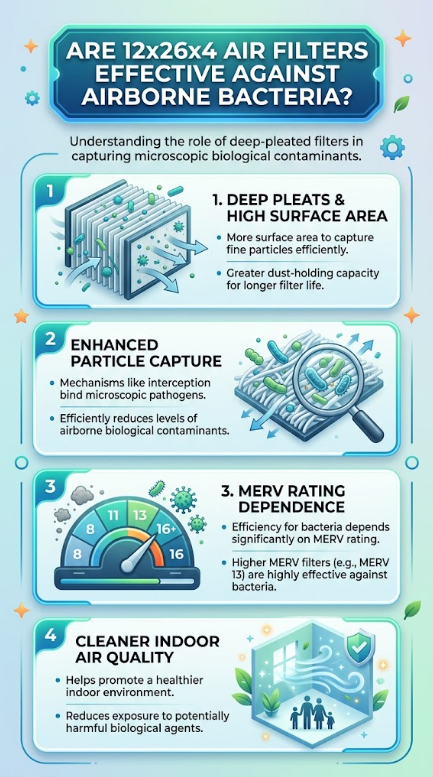
A 12x26x4 air filter is a residential HVAC filter measuring 12 inches tall by 26 inches wide by 4 inches deep. The 4-inch depth sets it apart from standard 1-inch filters — more filter media means longer contact time with circulating air, higher particle capture efficiency per pass, and a service life of 6 to 12 months versus the 1 to 3 months a 1-inch filter delivers.
Key facts about 12x26x4 air filters:
Filter dimensions: 12" x 26" x 4" (nominal)
Filter type: Deep-media pleated; requires a compatible media cabinet or deep-slot return
Available MERV ratings: Typically MERV 8, MERV 11, and MERV 13
MERV 13 captures: Particles down to 0.3 microns — the range where airborne bacteria, fine allergens, and combustion particles fall
Recommended replacement schedule: Every 6 months in humid or high-pollen climates; up to 12 months in lower-load environments
Best application: Homes where better air quality, longer filter life, and reduced HVAC maintenance are priorities
After manufacturing millions of filters in this size, what we've learned is straightforward: the 12x26x4 format gives most residential systems the most filtration per dollar spent — but only when the MERV rating is matched to what the homeowner actually needs to capture.
Top Takeaways
MERV 13 is the threshold for bacterial capture. Below it, particles in the 0.3–1.0 micron range — where most household airborne bacteria live — pass through the filter media.
The 4-inch depth isn't a minor upgrade. More filter media means longer air-to-fiber contact time, higher capture per pass, and a 6–12 month service life versus the 1–3 months from a 1-inch filter at the same MERV rating.
A reversed filter is a bypassed filter. If the airflow arrow faces the wrong direction, unfiltered air skips the media entirely and the MERV rating becomes irrelevant.
Replacement timing matters as much as MERV rating. A loaded MERV 13 filter loses efficiency before airflow drops noticeably. In Florida's climate, six months is a more realistic ceiling than twelve.
Filters reduce airborne bacteria. They don't sterilize air. Combine filtration with humidity control and proper ventilation for reliable, consistent protection.
MERV 11 works for older systems that can't handle MERV 13 static pressure. Forcing a high-efficiency filter into equipment not built for it creates its own problems.
The most commonly sold residential filter — MERV 8 — was never designed for the bacterial size range. Most homeowners don't know this until they check the specs.
How MERV Ratings Determine Bacterial Filtration in a 12x26x4 Filter
The MERV scale runs from 1 to 16. Higher numbers capture smaller particles. That single fact separates a filter that protects your family from one that only protects your equipment.
What MERV Rating Captures Bacteria?
Airborne bacteria in residential environments typically measure between 0.3 and 1.0 microns. Here's how the scale maps to that range:
MERV 1–7: Built for large particles — pollen, dust, pet hair. Bacteria pass through freely.
MERV 8–11: Captures some finer particles but inconsistently in the bacterial size range. The most common residential filter sold, and not designed for bacterial capture.
MERV 13–16: Captures particles down to 0.3 microns with high efficiency. The CDC formally recommends MERV 13 or better for central HVAC systems where improved filtration is the goal.
We've seen the downstream difference in homes that upgraded from MERV 8 to MERV 13: cleaner coil surfaces, less biological buildup in duct liners. When we see that, we know the filter was doing its job.
Why the 4-Inch Depth of a 12x26x4 Filter Matters
A 1-inch and a 4-inch filter at the same MERV rating are not the same filter. The deeper the media bed, the longer the air-to-fiber contact time — and contact time is where capture happens.
Air spends more time against the filter fibers, capturing more bacterial particles per pass.
The filter loads more slowly, which extends service life without a pressure penalty.
Less pressure drop per unit of filtration means the HVAC motor runs easier over the long term.
After producing this size across millions of units, we can say this clearly: the 4-inch pleated format consistently outperforms thinner alternatives at the same MERV rating. The physics don't change by brand.
MERV 11 vs. MERV 13 — Which Is Right for Your System?
For homes built in the last 15–20 years, MERV 13 is the right call. Modern systems handle the static pressure without complaint.
MERV 11 makes sense in two specific situations: older HVAC systems built around lower static pressure tolerances, and homes where a technician has already flagged airflow restrictions. If neither applies to you, go to MERV 13.
Your system's documentation lists its static pressure rating. A NATE-certified technician can also measure it in under ten minutes and give you a direct answer.
How to Install a 12x26x4 Air Filter Correctly
The installation takes four minutes. The most common mistake costs homeowners the entire protection window of a MERV 13 filter, and most people don't catch it until the next change.
Turn off your HVAC at the thermostat or breaker before handling the filter.
Remove the old filter. Before you toss it, look at the airflow direction arrow on the frame — that's your reference for the new one.
Confirm the slot depth. Four-inch deep filters require adequate cabinet space. Some older systems need a media cabinet retrofit first.
Insert the new 12x26x4 with the airflow arrow pointing toward the blower — not toward the return duct.
Close the access panel completely. Any gap around the filter frame creates an air bypass, and unfiltered air takes the path of least resistance.
Restart the system. Write the installation date on the filter frame, or set a six-month reminder on your phone.
Pro Tip: After years of service calls, the reversed filter is the most consistent installation mistake we come across. The air just routes around the media. At that point, MERV 13 is meaningless.
Which 12x26x4 Air Filter Is Best for Bacterial Control?
Not every 12x26x4 filter performs equally at the same MERV rating. Media quality, frame seal integrity, and pleat density all affect whether the rated efficiency holds across the filter's full service life.
Our Recommendation for Most Homes
A MERV 13 pleated 12x26x4 filter handles bacterial particles, seasonal allergens, and fine particulate simultaneously without requiring any system modification on most modern HVAC equipment. That combination is what makes it the right fit for the majority of residential systems.
When MERV 11 Is the Better Call
Older HVAC systems — roughly anything installed more than 20 years ago — were designed around lower static pressure tolerances. Running a MERV 13 through equipment built for MERV 8 can reduce airflow enough to affect performance, efficiency, and eventually hardware life.
MERV 11 gives you a meaningful step up from the standard MERV 8 while staying within a pressure range older equipment handles well. A NATE-certified technician can measure your system's static pressure and tell you exactly which MERV it supports.
How Often Should You Replace a 12x26x4 Air Filter for Bacteria Control?
A 4-inch pleated MERV 13 filter can last 6 to 12 months. The deeper media bed loads more slowly than a 1-inch filter. But that range assumes average household conditions — and most homes don't qualify.
Signs It's Time to Replace
Filter media has turned gray or dark brown instead of its original white or off-white.
Allergy or respiratory symptoms have increased without a clear outdoor trigger.
Airflow from supply vents has dropped noticeably.
Dust builds up on surfaces faster than usual despite regular cleaning.
Twelve months have passed — regardless of how the filter looks.
Why Florida Homes Need to Replace Sooner
Year-round HVAC operation, oak and citrus pollen, persistent humidity, and tightly sealed homes put more biological load on filter media than most other climates. What we've learned from years of service calls across Central Florida is that effective bacterial capture typically ends before homeowners notice any change in airflow. Six months is a more realistic ceiling than twelve for most Florida households.
What Airborne Bacteria Do 12x26x4 Filters Actually Capture?
Common Household Airborne Bacteria
The most frequently identified airborne bacteria in residential environments include:
Staphylococcus (including Staph. aureus): Shed from skin and respiratory tracts. Particle size: 0.5–1.5 microns.
Streptococcus: Respiratory origin. Typically 0.5–2.0 microns in diameter.
Mycobacteria: Carried indoors on clothing and shoes from soil and water sources. Falls within the MERV 13 capture range.
What a Filter Can — and Can't — Do
A MERV 13 12x26x4 filter cuts the airborne bacterial load in your circulating air significantly. Every pass through the system captures more particles. That's real, measurable protection.
What it can't do is make your indoor air sterile. Source control — managing humidity, improving ventilation, keeping HVAC components clean — works alongside your filter, not instead of it. We build our filters to be your first line of defense. The rest of the system still has to do its part.

"In fourteen years of pulling filters out of Central Florida air handlers, the ones that surprise homeowners most aren't the dirty ones — they're the MERV 8s that look almost clean after six months, because the particles they couldn't capture just kept circulating; switching those homes to a MERV 13 12x26x4 is the single change I recommend before anything else, because the coil stays cleaner, the air quality improves, and the system runs the way it was designed to."
7 Essential Resources
Each source below was confirmed live and independently published by a government agency or nonprofit health organization.
1. Biological Pollutants' Impact on Indoor Air Quality — U.S. EPA
https://www.epa.gov/indoor-air-quality-iaq/biological-pollutants-impact-indoor-air-quality
The EPA's primary guidance on airborne biological contaminants in residential environments — including bacteria, mold, and viruses — and why humidity control and proper filtration are the two most practical household interventions.
2. Improving Air Cleanliness Through Filtration — CDC/NIOSH
https://www.cdc.gov/niosh/ventilation/prevention/air-cleanliness.html
The CDC formally recommends upgrading central HVAC filter efficiency to MERV 13 or better when enhanced outdoor air delivery is limited — the definitive federal guidance on filtration and biological contaminants in residential and commercial buildings.
3. Indoor Air Quality — National Institute of Environmental Health Sciences (NIEHS)
https://www.niehs.nih.gov/health/topics/agents/indoor-air
NIEHS research confirms that indoor pollutant concentrations are rising due to tighter building construction, higher humidity, and reduced natural ventilation — making high-efficiency HVAC filtration increasingly important for residential health outcomes.
4. Why Healthy Indoor Air Quality Is Important — Asthma and Allergy Foundation of America (AAFA)
https://community.aafa.org/blog/why-healthy-indoor-air-quality-is-important
AAFA's practical guidance for homeowners managing allergens and airborne irritants — including the recommendation to use certified HVAC filters and keep indoor humidity below 50% to limit biological growth.
5. HVAC Proper Installation of Filters — U.S. Department of Energy Building Science Education
https://bsesc.energy.gov/energy-basics/hvac-proper-installation-filters
The DOE's building science guidance on how HVAC filters work, why correct sizing and placement matter, and how improper installation undermines both air quality protection and system efficiency.
6. Air Cleaning — American Lung Association
https://www.lung.org/clean-air/indoor-air/protecting-from-air-pollution/air-cleaning
The American Lung Association recommends MERV 13 or higher for residential HVAC systems, noting that higher-rated filters capture smaller particles without significant airflow loss in modern equipment.
7. Air Filter Overview — Wikipedia
https://en.wikipedia.org/wiki/Air_filter
A grounding reference on how mechanical air filtration works — including particle capture physics, MERV rating history, and the practical differences between filter types — useful context for homeowners comparing options.
3 Supporting Statistics
Indoor pollutant concentrations are often 2 to 5 times higher than outdoor levels.
1. Americans spend roughly 90% of their time indoors
Source: U.S. EPA — Indoor Air Quality Report on the Environment
The air your family breathes most is also the air most likely to carry concentrated biological pollutants. A 12x26x4 MERV 13 filter is the most practical way to reduce that load during the hours your HVAC runs — which, in most homes, is most of the day.
"Upgrade central HVAC filter efficiency to MERV-13 or better."
2. CDC/NIOSH formally recommends MERV 13 or better for central HVAC systems
Source: CDC/NIOSH — Improving Air Cleanliness
This is the federal standard, not a manufacturer claim. When the CDC recommends a specific MERV threshold, it reflects research on particle capture efficiency across biological contaminants. Our MERV 13 12x26x4 filters are manufactured to meet that standard.
MERV 8 is rated for particles down to 3.0 microns — ten times larger than the bacteria it misses.
3. Most airborne bacteria fall within the 0.3–1.0 micron particle size range
Source: EPA — Biological Pollutants' Impact on Indoor Air Quality
That single specification gap is the clearest reason to upgrade. If the filter's rated range doesn't cover the particle, it can't capture it. A MERV 13 filter is rated down to 0.3 microns. The math is simple, and the protection difference is real.
Final Thoughts & Opinion
After manufacturing millions of air filters and hearing back from thousands of households, our position is clear: a 12x26x4 filter at MERV 13 is the single highest-impact upgrade most residential HVAC systems can support. It costs a few dollars more than a MERV 8. It lasts six times longer than a 1-inch filter. And it captures the bacterial particles that a standard residential filter lets pass through unchecked.
The honest caveat: filtration is a first line of defense, not a complete solution. Source control — humidity management, ventilation, keeping HVAC components clean — works with your filter, not instead of it. But if we were recommending one change to homeowners who want better bacterial air quality, upgrading to a correctly sized and properly installed MERV 13 filter is it. Every time.
You're already maintaining your home. You're already thinking about protecting the people inside it. The right filter makes that effort count more.
Frequently Asked Questions
What MERV rating do I need in a 12x26x4 air filter to capture airborne bacteria?
MERV 13, at a minimum. Airborne bacteria measure 0.3 to 1.0 microns. A MERV 13 filter captures particles down to 0.3 microns at high efficiency. MERV 8 — the most common filter in residential systems — is rated down to 3.0 microns and misses most bacterial particles entirely. For the best 12x26x4 air filter for bacterial control, MERV 13 is the clear choice for modern systems. If your equipment is older or an HVAC technician has flagged static pressure concerns, MERV 11 is the next best option.
How do I install a 12x26x4 air filter correctly?
Turn off your HVAC before handling the filter. Remove the old one and note the airflow direction arrow on the frame before discarding it. Check that your filter slot accommodates a 4-inch deep filter — some older systems need a media cabinet retrofit first. Insert the new filter with the airflow arrow pointing toward the blower, not away from it. Close the access panel fully, with no air gaps around the frame. Restart the system. The most common air conditioner filter 12x26x4 installation mistake we see is a reversed filter — it sends unfiltered air around the media entirely.
Can a 12x26x4 air filter remove viruses as well as bacteria?
A MERV 13 filter can capture some virus-carrying droplet nuclei, because those carriers often fall in the 0.3–1.0 micron range. Free-floating virus particles, however, can measure below 0.1 microns — smaller than MERV 13's rated capture range. For virus-specific concerns, MERV 16 or HEPA filtration provides more coverage. A MERV 13 12x26x4 filter is a meaningful reduction in airborne biological load. It's not a complete viral barrier, and we won't tell you it is.
How often should I replace my 12x26x4 air conditioner filter?
The general guidance for a 12x26x4 air conditioner filter at MERV 13 is every 6 to 12 months. The 4-inch depth provides far more media surface area than a 1-inch filter, which extends service life considerably. That said, homes in humid climates — particularly Central Florida, where HVAC runs year-round and pollen from oak and citrus trees is a constant factor — should replace closer to six months. The filter media saturates for bacterial capture before airflow feels different, so visual inspection alone isn't a reliable indicator.
Is a 12x26x4 air filter better for bacteria than a standard 1-inch filter at the same MERV rating?
Yes, and the difference is real. The 4-inch depth of a 12x26x4 filter provides far more filter media surface area than a 1-inch filter at the same MERV rating. More media means longer air-to-fiber contact time, higher particle capture efficiency per pass, and a replacement interval that runs four to six times longer. Both filter formats serve different system configurations — 1-inch filters work for systems without deep media cabinets — but wherever a 12x26x4 fits your equipment, it delivers meaningfully better protection.
Ready to Upgrade Your Home's Air Protection?
Browse our full selection of 12x26x4 air filters — available in MERV 8, 11, and 13 — and find the right level of protection for your HVAC system and household. Choose the MERV rating that fits your system, and your family starts breathing cleaner air with the very next filter change.Learn more about HVAC Care from one of our HVAC solutions branches…
Filterbuy HVAC Solutions - Miami FL - Air Conditioning Service
1300 S Miami Ave Apt 4806 Miami FL 33130
(305) 306-5027